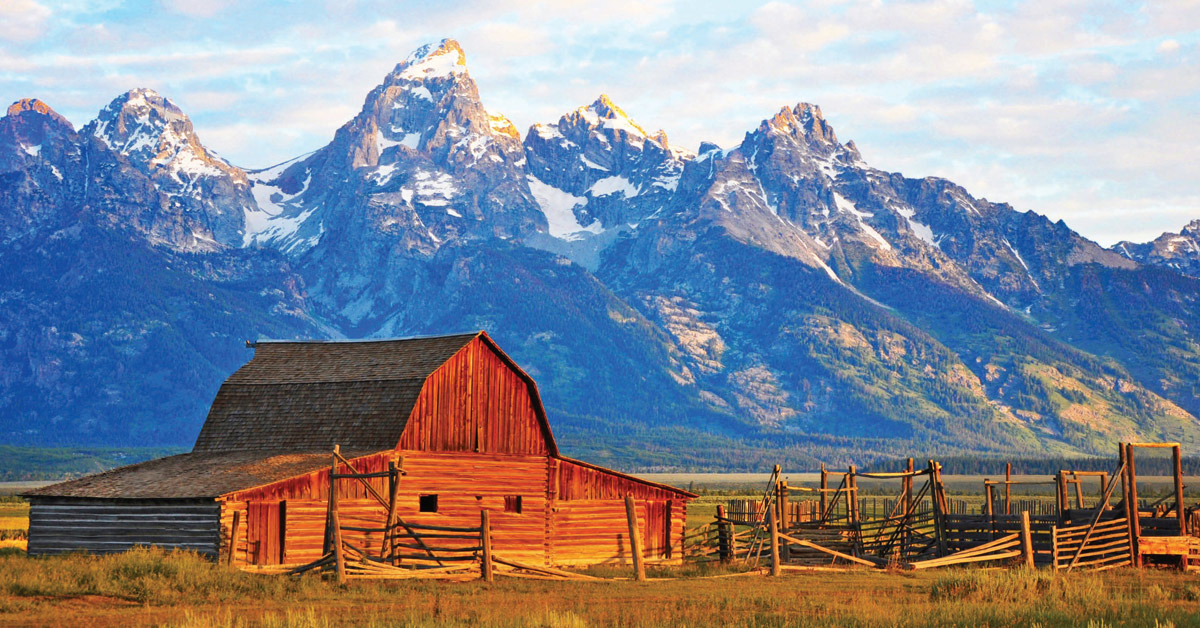
The Mountain Region — which is comprised of the states of Colorado, Idaho, Montana and Wyoming — has steadily recovered from COVID-19. Known for its wide-open spaces and scenic beauty, portions of this region have been among the fastest-growing areas of the country.
According to the U.S. Census Bureau, the populations of Idaho and Colorado grew by 16.3% and 15.1%, respectively, over the past decade and collectively added more than a million people during this time. The housing markets in Boise and Denver have been among the hottest in the nation during the pandemic.
Gross domestic product (GDP) growth in first-quarter 2021 for Colorado (7.9%) and Montana (7.2%) beat the national average of 6.4% while the annualized GDP growth rate for Idaho (5.9%) and Wyoming (5.1%) lagged the pace of growth for most neighboring states. Colorado has the largest economy in this region with a GDP of $390.1 billion in 2020, ranking 16th in the nation. More than half of Colorado’s nearly 5.8 million residents live in the Denver metro area (population 3 million).
 Advanced manufacturing is a dominant industry in Colorado. IBM, Oracle and Arrow Electronics are just a few of the manufacturing companies with operations in the Centennial State. Agriculture and food processing also are major industries. Colorado is famous for the Rocky Mountains and its winter sports, with Aspen and Vail serving as favored ski destinations of the jet set.
This past spring, the University of Colorado at Boulder’s Leeds School of Business predicted that the state, while growing at a steady pace, isn’t likely to fully recover from its pandemic-related downturn until 2022. At 6.2%, Colorado’s unemployment rate this past June was the region’s highest. Unemployment in the other Mountain Region states ranged from 3% in Idaho to 5.4% in Wyoming, and each were lower than the national average of 5.9% in June.
Idaho is best known as the nation’s leading producer of potatoes (a reputation promoted by the “Famous Potatoes” tag line that appears on many license plates). Boise is home to micro- chip manufacturer Micron, and the late Joe Albertson founded the Albertsons chain of supermarkets just north of downtown Boise. Nearly half of Idaho’s 1.8 million residents live in the fast-growing state capital (metro-area population of 790,000).
Wyoming ranked 50th among state populations in 2020 and its GDP last year was the second-smallest in the nation at $36.2 billion. The state’s per capita personal income, however, ranked 11th in the nation thanks in part to higher-than-average earnings in the mining industry. Wyoming also has also been successful in attracting data centers, spurred on by a $750 million-plus investment by Microsoft near Cheyenne.
In Montana, meanwhile, food processing piggy-backs on the state’s significant agricultural output. Forestry, mining and energy production also are significant industries. ●
Boise Office Market
 Although Boise’s office-vacancy rates have remained significantly lower than the national average through the pandemic, vacancies have been on the rise of late. The vacancy rate stood at 8.6% as of second-quarter 2021, up 3.6 percentage points year over year, according to Cushman & Wakefield. Meanwhile, asking rents rose for four consecutive quarters to reach $20.70 per square foot.
Cushman & Wakefield reported that several large tenants were seeking space in the downtown area, but net absorption for the metro-area office market was at negative 82,000 square feet year over year as of second-quarter 2021. Still, competition among investors remained fierce for the few available office properties.
The high price of lumber and construction materials, as well as a scarcity of labor, has put a number of construction projections on hold. Cushman & Wakefield predicted that landlords would push for longer-term leases even as tenants were seeking more flexibility.
Focus: Energy
Energy production is a major industry in the Mountain Region. Nationally, Wyoming ranked eighth in production of crude oil and natural gas in 2019 with more than 25,000 active wells. The state also is one of the nation’s largest producers of coal. Although Wyoming’s coal production was down 21% year over year in 2020, the state still produced 218 million tons of coal last year.
In Montana, more than 29,000 people are employed in the oil and gas industry. There are four oil refineries in the state with a total capacity of 205,000 barrels per day. It is estimated that Montana has a quarter of the nation’s recoverable coal reserves.
Meanwhile, oil drilling has taken place in Colorado since 1860, and the state ranked a respective sixth and seventh among all states for oil and natural gas production in 2019. Colorado also ranks eighth in estimated recoverable coal reserves.
What the locals say
“The desirability of (Denver’s) marketplace from the standpoint of employers and employees has allowed us to rebound quickly from the dark days of COVID. There’s been both employment growth and migration growth. … The economy fully reopened in late May, which got a spike from (July’s) MLB All-Star Game. All of this has really driven activity across commercial real estate. Although we have quite a lot of multifamily supply, we saw record absorption for multifamily in the second quarter of 2021. The industrial market has been absorbed as soon as projects are out of the ground due to the demand from e-commerce. ”

Eric Tupler
Senior managing director, JLL Capital Markets
3 Cities to Watch
Colorado Springs
 Colorado’s second-largest city, with a metro-area population of about 763,000, has an economy that is dominated by defense corporations that feed off the area’s multiple military installations. Fort Carson, Peterson Air Force Base, Schriever Air Force Base, the North American Aerospace Defense Command and the U.S. Air Force Academy are located near the city. Colorado Springs is located at the base of the Rocky Mountains, which draws tourists to stunning geologic formations, including Pikes Peak.
Billings
 Billings is the largest city in Montana with a metro-area population of about 185,000. Located in the fertile Yellowstone Valley, its economy is heavily agriculture-based, with sugar beets, grain and livestock among the largest commodities. The surrounding mountains are a source of coal, oil and natural gas, and several refineries are located in the area. As of this past April, Yellowstone County’s unemployment rate was 3.5%, or 1.4 percentage points lower than the U.S. average for the same month.
Cheyenne
 Wyoming’s state capital and largest city, Cheyenne was founded shortly after the Civil War with the coming of the Union Pacific’s transcontinental railroad. Burlington Northern Santa Fe and Union Pacific still employ a significant number of residents. F.E. Warren Air Force Base is another major employer. As of second-quarter 2021, the metro area had 13% fewer commercial properties listed for sale compared to a year earlier, according to the Wyoming Center for Business and Economic Analysis.
Sources: Brittanica; Casper Star Tribune; City of Cheyenne; City-Data.com; Cushman & Wakefield; Encyclopedia.com; Encyclopedia of the Great Plains; Energy News Network; Idaho State Department of Agriculture; Forbes; Montana Environmental Information Center; Montana Petroleum Association; Petroleum Association of Wyoming; The Center Square; U.S. Bureau of Economic Analysis; U.S. Bureau of Labor Statistics; U.S. Census Bureau; U.S. Chamber of Commerce; U.S. Department of Labor; U.S. Energy Information Administration; Trading Economics; WalletHub; WorldAtlas.com; World Population Review; Wyoming Center for Business and Economic Analysis; Wyoming State Geological Survey; Yelp