
California’s influence on American culture is undeniable. Hollywood is the epicenter of the global film industry and helps to generate $40 billion a year in worldwide ticket sales for theaters. Artists like Bob Dylan, Coldplay, Michael Jackson and Van Halen have passed through the doors of Los Angeles’ recording studios. Disneyland, the Golden Gate Bridge, Yosemite National Park and the San Diego Zoo are among the Golden State’s iconic tourist destinations.
California also has an outsized economic presence. Prior to a significant contraction caused by the COVID-19 pandemic, its $3.1 trillion gross domestic product (GDP) outpaced nations such as France, India and the United Kingdom. California’s compound annual GDP growth of 3.3% from 2009 to 2019 was a full percentage point higher than the U.S. average while the state’s per capita income of $66,619 in 2019 was 18% higher than the nation as a whole.
 According to a winter 2020 report from Allen Matkins law firm and the UCLA Anderson School of Management, commercial real estate developers were becoming more optimistic about California’s major asset classes. Six months earlier, developer sentiments for the state’s multifamily, office, retail and industrial sectors were almost entirely negative. The most recent survey, however, indicated a largely positive outlook over the next three years as many developers are likely to get an early start on the next expansion cycle.
Still, there are concerns for California’s long-term sustainability. A report this past October in The New York Times posited that companies may leave the state due to high taxes and high costs of living for employees. State government officials are grappling to reduce urban sprawl, which has undermined efforts to reduce auto emissions and has placed more homes in areas prone to wildfires, the report stated.
Like other areas of the nation, California’s retail businesses have struggled during the pandemic. The governor’s office reported this past August that 44% of the state’s small businesses were at risk of closure, with minority-owned businesses being disparately impacted. California’s legal-cannabis industry, however, has shown resilience as dispensaries remained open throughout the pandemic. Voters approved 32 local measures this past November to legalize and tax marijuana, which should add to California’s head count of 715 licensed storefronts and accelerate tax revenues that have topped $1.45 billion since 2018.
In a statewide ballot measure last year, California voters rejected Proposition 15, which would have rolled back commercial real estate tax protections that have been in place since 1978. The measure would have raised an estimated $6.5 billion to $11.5 billion annually for local governments and schools, but opponents such as business groups and the real estate industry claimed the tax hikes would have been passed on to tenants and consumers. ●
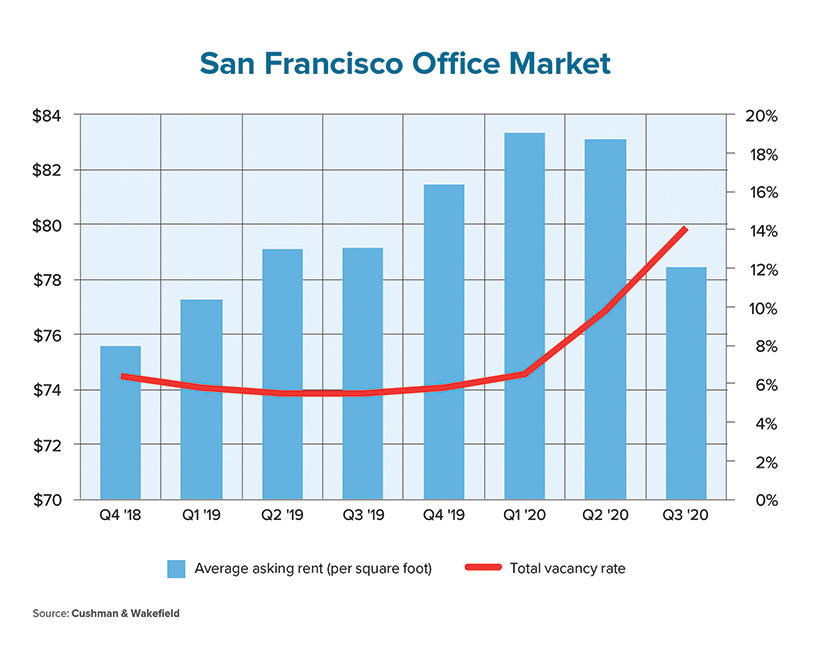 In a third-quarter 2020 report, Cushman & Wakefield noted that San Francisco’s office-property asking rents remained the highest of any major U.S. market at $78.45 per square foot. This figure, however, was down 5.6% from the prior quarter and down 0.8% on a yearly basis. Although rents remained relatively stable, the marketwide vacancy rate soared to 14.1%, an increase of 860 basis points from a year earlier.
Pandemic-related shelter-in-place restrictions greatly impacted the ability to sign new tenants, the company reported. Across the San Francisco market, only 385,000 square feet of new leases were signed in Q3 2020, a 30-year low. By comparison, the dot-com bust of the early 2000s saw this quarterly figure bottom out at 933,000 square feet. But there is good news on the horizon: San Francisco has 1.4 million square feet of new office space set to be delivered by midyear 2021 and all of it has been preleased.
Focus: Healthcare
As of this past December, California surpassed 1.5 million confirmed cases of COVID-19 — the most in the nation, according to The New York Times — although it ranked near the bottom of all states for positive cases per 100,000 residents. Still, the virus was spreading there and California became the first state to record 30,000 cases in one day, including more than 12,000 in Los Angeles County alone.
A report this past June from the California Health Care Foundation noted that Gov. Gavin Newsom had requested an additional 50,000 hospital beds for inpatient needs. Increases in overtime pay and temporary staffing were contributing to a monthly revenue decline of $3.2 billion across the state’s hospitals, a 37% drop from pre-pandemic levels. Much of this deficit hadn’t been backfilled by federal aid. The pandemic figures to remain a burden on California’s health care system in 2021.
What the locals say
“In California — specifically Southern California — I would say retail and office (properties) are obviously hit the hardest. We’ve seen rent deferrals in terms of the tenants in our portfolio now. … With rents, people underwriting to a pro forma of their value-add strategy are now looking back and bringing the numbers down, maybe not doing as much value add as they were before, as the yields wouldn’t make sense in that regard. They are not performing their value add or pumping the brakes on their value-add strategy, and waiting to see what happens so that they can underwrite to the right rents.”

Marissa Wilbur
Vice president of originations, Archway Capital
3 Cities to Watch
Fresno
 Fresno is California’s fifth most-populous city with about 538,000 residents and has grown by about 8% over the past decade, census figures show. It is located in the San Joaquin Valley near the state’s geographic center. Fresno County was the nation’s top agriculture-producing county in 2018 with a value of $7.9 billion. Almonds, pistachios, grapes, poultry and garlic are among the top local ag products. Manufacturing companies employ 105,000 and generate $15 billion annually across the regional economy.
Los Angeles
 Unemployment in the L.A. metro area reached a high of 19.3% this past May and still stood at 11% in October — 410 basis points higher than the U.S. rate for the same month. The leisure and hospitality sector was recovering but employment was still down 24% year over year in November. According to CBRE, L.A.-area industrial properties remain in high demand. Prices fell and capitalization rates rose for these properties, but the $1.4 billion in transactions during Q3 2020 exceeded the average of the previous five quarters.
Sacramento
 The state capital has about 2.4 million metro-area residents and appears to be benefiting from a migration out of the Bay Area. A recent report in The Mercury News showed Sacramento’s median home value was about one-third of San Francisco’s and San Jose’s, while Sacramento apartment rents experienced one of the largest annual hikes in the U.S. at 4.3%. The office market dipped, however, with leasing activity in Q2 2020 at about 50% of its five-year quarterly average, Colliers International reported.
Sources: American Enterprise Institute; California Health Care Foundation; CBRE; Colliers International; Cushman & Wakefield; Leafly; Office of the Governor of California; San Francisco Chronicle; San Joaquin Valley Manufacturing Alliance; The Fresno Bee; The Hollywood Reporter; The Mercury News; The New York Times; Tunedly; UCLA Anderson School of Management; U.S. Bureau of Economic Analysis; U.S. Bureau of Labor Statistics; U.S. Census Bureau; World Population Review