

The COVID-19 pandemic has hurt the Southwest Region states to varying degrees. One notable characteristic of this region — comprised of Arizona, Nevada, New Mexico and Utah — has been its growth, which should help drive recovery.
These states have seen significant in-migration over the past decade and are popular with retirees. Given the warm weather, relatively affordable costs of living and diverse economies, the Southwest is projected to remain a fast-growing region.
 In the short term, however, the recovery has been uneven. Nevada’s tourism- and gambling-dependent economy was especially devastated by prolonged shutdowns while Utah emerged quickly and relatively unscathed.
The Southwest states saw solid gross domestic product growth on a quarterly basis in fourth-quarter 2020 that ranged from 7.1% in Utah to 2.5% in New Mexico. But the recovery from job losses has varied.
As of March 2021, Utah was tied with two other states for the lowest unemployment rate in the nation at 2.9%. New Mexico, Nevada and Arizona, however, had respective jobless rates that were the third, fourth and 14th highest among all states.
Each of the Southwest states ranked in the bottom half last year for per capita income. Among these states, Nevada had the highest per capita income in 2020 at $53,635, 30th in the nation. Utah, Arizona and New Mexico ranked 34th, 42nd and 48th, respectively.
Arizona had the largest economy in this region in 2020 at $372.5 billion, ranking 19th among all states. Phoenix is the fifth-largest city in the U.S. and has a metro-area population of 5.2 million people. Other major cities in the Southwest include Las Vegas and Reno, Nevada; Tucson, Arizona; Salt Lake City; and Albuquerque, New Mexico.
These states rely on tourism to varying degrees and this region also is a retirement mecca. Tech companies, in particular, have been opening offices or relocating to these states while shifting away from Silicon Valley and other higher-cost coastal areas.
Mining, aerospace and agriculture are major industries in Arizona. The electronic parts distributer Avnet and the solid waste company Republic Services are headquartered in Phoenix. Aside from glittering resorts along the Las Vegas Strip, Nevada is known for its gold, silver and copper mining, and it is home to Nellis Air Force Base near Las Vegas.
New Mexico, meanwhile, is a leader in cybersecurity. Six major research labs related to national defense and security are located in the state, including Los Alamos National Laboratory. Several manufacturers operate plants in New Mexico, including Intel and General Mills.
Utah has seen an influx of tech companies around Salt Lake City, which also serves as a hub for financial services and life sciences. One of the state’s largest employers, however, is the Swedish manufacturer Autoliv ASP, which makes air bags and other auto-safety equipment at a plant in Ogden.
 The Salt Lake City office market started strong in 2020 but had four consecutive quarters of occupancy losses through first-quarter 2021 as companies began to shed space due to the onset of the COVID-19 crisis, according to Cushman & Wakefield. The overall vacancy rate was up by 7.2 percentage points year over year as of Q1 2021. Companies were pulling back to reduce their space and lessen risks during the pandemic.
Cushman & Wakefield reported that tech-based tenants have been driving positive-absorption trends. The city has established itself as one of the top 10 tech markets in the U.S., with such tenants as eBay, Overstock.com and Adobe.
Tech companies are responsible for 8.3% of all jobs in the Salt Lake metro area, much higher than the national rate of 5.3%. And the metro-area unemployment rate of 3.2% at the end of Q1 2021 was 280 basis points lower than the U.S. rate.
Focus: Technology
Startups and established tech firms have been looking at the Southwest as an alternative to California’s high-cost Silicon Valley. In Arizona, tech is the fastest-growing industry and now accounts for more than 250,000 jobs across some 9,500 companies. Utah, meanwhile, had the second-fastest tech-job growth rate among all states from 2008 through 2018. The tech industry accounts for roughly one in seven jobs in the state.
In New Mexico, tech companies are piggybacking on several established industries within the realms of engineering, information technology, aerospace and solar energy. There were more than 3,000 technology companies in the state in 2019, according to the Computing Technology Industry Association.
Nevada is aggressively trying to woo large tech firms to the state. Earlier this year, the governor’s office announced planned legislation to entice these companies by creating “smart cities” on uninhabited land, effectively allowing these companies to form an alternative form of government in these areas.
What the locals say
“Our economy in Phoenix is now much more diversified than it was in 2008 and 2009. We have tons of variety in our economy now and in the workers here, whereas eight or nine years ago it was very real estate driven. Phoenix has grown as a city in the last 12 years and it doesn’t feel like this is unsustainable. It feels very organic and that they’ve done things in the right way. The city itself is doing everything it can to take businesses out of California. And it seems every month, I’m seeing a new semiconductor chip facility going in, or someone moving their headquarters over here or opening a new office over here.”

Patrick O’Donnell
Vice president
George Smith Partners
3 Cities to Watch
Santa Fe
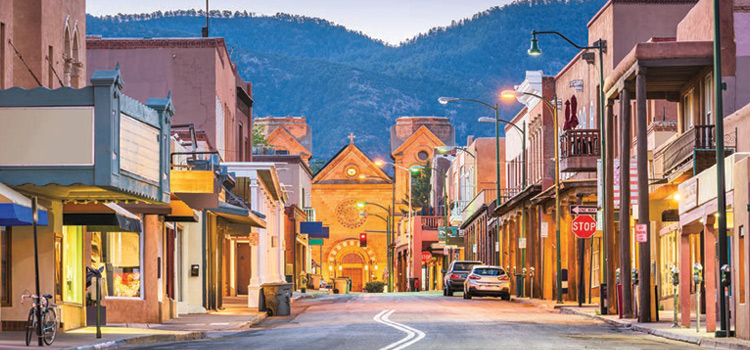 Santa Fe is the capital of New Mexico and has an estimated population of 86,000. Founded in the early 1600s in Spanish-held territory, it is the oldest capital city in the U.S., and at an elevation of more than 7,000 feet, it is the highest capital in the U.S. Recently, Los Alamos National Laboratory announced an expansion in the city by leasing nearly 80,000 square feet of office space with plans to relocate 500 administrative services staff.
Provo
 Provo is the fourth-largest city in Utah and has a metro-area population of some 678,000. Home to Brigham Young University, the city has become a tech hub for the state. In 2018, software giant Adobe broke ground on a $90 million facility to employ 1,000 in nearby Lehi. Provo also forms part of the state’s so-called “Silicon Slopes,” which is described as a fast-growing cultural and economic hub between Provo and Salt Lake City.
Flagstaff
 Located at nearly 7,000 feet near the base of the San Francisco Peaks, Flagstaff has a population of about 78,000. It is the county seat for Coconino County, which at 18,608 square miles is the second-largest county in the U.S. Northern Arizona University is the city’s largest employer, and Flagstaff is home to the Lowell Observatory, where Pluto and the rings of Uranus were first discovered. The famed Route 66 also runs through Flagstaff.
Sources: Albuquerque Journal; Britannica.com; CNN; Computing Technology Industry Association; Cushman & Wakefield; Deseret News; Encyclopedia.com; Forbes; Los Alamos National Laboratory; Lowell Observatory; New Mexico Economic Development Department; SantaFe.com; The Associated Press; The Center Square; Trading Economics; U.S. Bureau of Economic Analysis; U.S. Bureau of Labor Statistics; U.S. Census Bureau; U.S. Department of Labor; WorldAtlas.com; WorldCapitalCities.com; World Population Review